North Sea as a Meteorological Environment
The North Sea receives weather systems from the North Atlantic via the gap between Scotland and Iceland. Depressions tracking eastward along this corridor — known to meteorologists as the North Atlantic storm track — frequently deliver gale-force winds to the southern North Sea and the German Bight. The eastern North Sea and German coastal zone are exposed from the north-west through west, with the longest fetch reaching several hundred kilometres in the prevailing wind direction.
Significant seasonal variation exists. Autumn and winter bring the strongest gales and highest surge frequencies. Summer conditions are generally milder, but sea fog and convective thunderstorms can develop rapidly over the southern North Sea. Spring and early summer see frequent north-easterly and north-northwesterly winds driven by high pressure over Scandinavia.
Sea state responds rapidly to wind changes over the shallow German Bight. With depths of 20–30 metres across much of the inner shelf, swell from the open Atlantic dissipates on entering the Bight, but locally generated wind waves can build quickly during strong wind events. A sustained Force 7 (near gale, 28–33 knots) blowing over 200 kilometres of fetch produces wave heights that can exceed 4–5 metres in the outer Bight within hours.
DWD Maritime Forecast Areas
The Deutscher Wetterdienst (DWD) issues maritime weather forecasts divided by sea area. The areas relevant to German coastal navigation include:
- German Bight (Deutsche Bucht) — covering the south-eastern North Sea from roughly Texel to Thyborøn
- Heligoland — the waters immediately around the island of Helgoland, which DWD also uses as an observation point
- Fisher, Dogger, German Bight — the international shipping forecast areas used in VHF and HF broadcasts, named in coordination with the UK Met Office nomenclature system
- Western Baltic — Kattegat, Belt and Fehmarn Belt areas for Baltic Sea passages
DWD publishes coastal weather forecasts on its website and via NAVTEX (navigational telex) broadcasts from the stations at Pinneberg (north of Hamburg) and Rostock-Warnemünde. NAVTEX transmissions for the German coast use character identifier G for Pinneberg and S for Rostock.
The Beaufort Scale in German Maritime Forecasts
German maritime forecasts use the Beaufort wind scale, as used across European maritime weather services. The scale runs from Force 0 (calm, less than 1 knot) to Force 12 (hurricane force, more than 63 knots). Gale warnings are issued by DWD when winds are forecast to reach Beaufort Force 7 or above in coastal or offshore areas. Storm warnings cover Force 10 and above.
| Beaufort | Description | Wind Speed (knots) | Sea State |
|---|---|---|---|
| 4 | Moderate breeze | 11–16 | Small waves, some whitecaps |
| 5 | Fresh breeze | 17–21 | Moderate waves, many whitecaps |
| 6 | Strong breeze | 22–27 | Large waves, spray |
| 7 | Near gale | 28–33 | Sea heaps up, streaks of foam |
| 8 | Gale | 34–40 | Moderately high waves, well-marked streaks |
| 9 | Strong gale | 41–47 | High waves, tumbling crests, spray |
| 10 | Storm | 48–55 | Very high waves, surface white with foam |
NAVTEX and VHF Broadcasts
NAVTEX provides automated text broadcasts of maritime safety information on 518 kHz (international, English) and 490 kHz (national, German). German coastal vessels should receive NAVTEX coverage from Pinneberg (G) and Rostock (S) across the entirety of German coastal waters. Broadcasts include weather forecasts, gale warnings, navigational warnings (Notams) and SAR notices.
VHF radio provides a supplementary channel. German maritime radio previously operated through Deutsche Telekom Küstenfunk, but the coastal radio station network has been progressively reduced. The MRCC (Maritime Rescue Coordination Centre) Bremen and MRCC Cuxhaven coordinate distress traffic and maintain listening watches on VHF Channel 16. Digital Selective Calling (DSC) on VHF Channel 70 is the primary distress alerting system under the GMDSS regime applicable in German coastal waters.

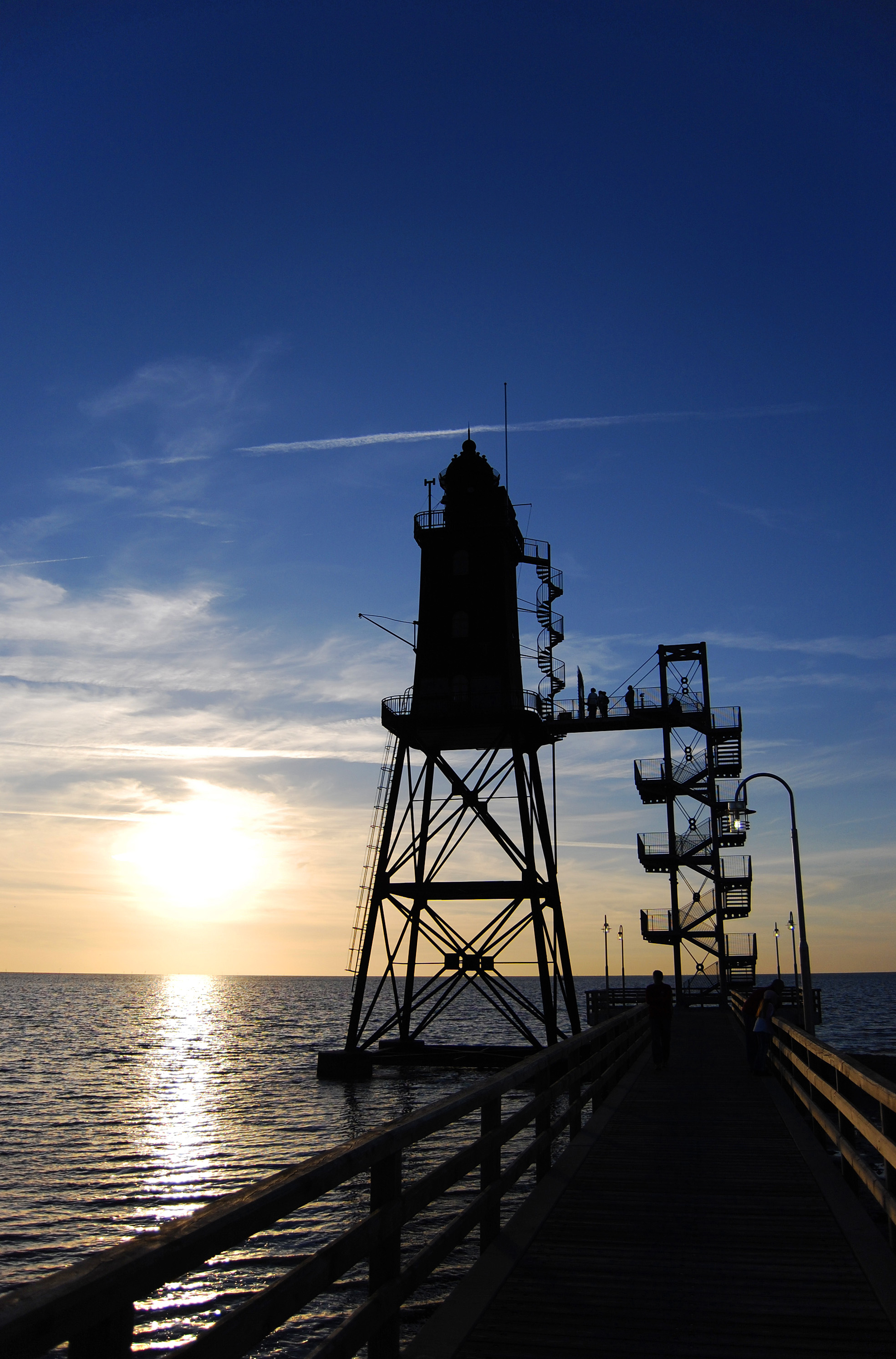
Westerheversand lighthouse, Schleswig-Holstein, stands isolated on the tidal flats accessible only at low tide on foot. (Wikimedia Commons / CC)
Fog and Visibility in the German Bight
Fog is a significant hazard in German coastal waters, particularly during spring and early summer when cold water temperatures persist from winter while air temperatures begin to rise. Advection fog — warm, moist air moving over cold North Sea water — can reduce visibility to under 100 metres with little warning. Fog signals from major lighthouses and light floats are listed in the BSH List of Lights (Leuchtfeuerverzeichnis).
The DWD issues visibility forecasts as part of the maritime area forecast. Poor visibility categories in German maritime forecasts follow COLREGS definitions: poor visibility is generally defined as under 5 nautical miles; dense fog is under 200 metres. Under COLREGS Rule 19, vessels in or near an area of restricted visibility must proceed at safe speed and have engines ready for immediate manoeuvre.
Helgoland as a Weather Observation Point
The island of Helgoland (Helgoland), approximately 70 kilometres offshore from the Elbe estuary mouth, hosts a DWD weather observation station. Wind and sea-state observations from Helgoland serve as a key data point for the German Bight forecast area. The island is also a reference waypoint for vessels navigating the outer approaches of the major estuaries — it lies between the Elbe, Weser and Jade approaches.
Key Weather Sources for German Coastal Waters
- DWD marine forecasts: dwd.de/shipping — area forecasts, gale warnings and sea-state information
- BSH storm surge service: Current and forecast surge levels for German coastal tide gauge stations
- NAVTEX 518 kHz: Automated broadcasts from Pinneberg (G) and Rostock (S)
- VHF Channel 16: Monitored by MRCC Bremen and MRCC Cuxhaven; used for distress and urgency traffic
- Elbe Traffic (VTS): VHF broadcast of navigational conditions and traffic information in the Elbe approach
Seasonal Patterns Summary
Autumn (September–November) marks the transition to active weather in the North Sea. The frequency of gale events increases, storm surges become possible, and the sea begins to cool from the summer peak. Winter (December–February) sees the highest gale frequencies and the greatest risk of storm surges. Spring (March–May) is characterised by variable weather, sea fog risk increasing as the air warms while the sea remains cold. Summer (June–August) is the calmest season on average, with periods of settled anticyclonic weather and the lowest gale frequency of the year, though convective squalls can be locally intense.

