IALA Region A: Scope and Application
All German coastal waters — the North Sea coast, the East Frisian Islands, the North Frisian Islands, the Kiel Fjord, the Western Baltic and the approaches to the major ports — fall within IALA Maritime Buoyage Region A. This region comprises Europe, Africa, parts of Asia, Australia and most of the world's oceans, and uses the red-to-port convention for lateral marks. This means that when a vessel is proceeding in the conventional direction of buoyage (generally from seaward inward, or from north and east along a coast), port-hand lateral marks are red and starboard-hand marks are green.
IALA Region A contrasts with Region B (the Americas, the Philippines, Japan and South Korea), where the convention is reversed: red marks to starboard when entering harbour. Mariners moving between the two regions must adjust their interpretation accordingly. Within German coastal waters, Region A applies consistently.
The authority responsible for establishing, maintaining and publishing navigational marks in German waters is the BSH (Bundesamt für Seeschifffahrt und Hydrographie). The BSH publishes the German List of Lights and Fog Signals (Leuchtfeuer- und Schallsignalverzeichnis) and the Berichtigungen (Notices to Mariners) that update charts as marks are added, moved, changed or discontinued.
Lateral Marks
Lateral marks define the sides of navigable channels. Under IALA Region A, the conventional direction of buoyage in German coastal waters generally runs from seaward to port — that is, from the open North Sea or Baltic towards harbour. For the Elbe, Weser, Ems and Jade estuaries, the conventional direction of buoyage is from seaward towards Hamburg, Bremen, Emden and Wilhelmshaven respectively.
Port-hand Marks (Red)
Port-hand lateral marks are red. Their shape is cylindrical (can-shaped) for buoys, and they may carry a single red cylindrical topmark. The light characteristic for port-hand marks uses red light with any rhythm. When passing to port of a red mark when inbound, the mark is left to the vessel's port side — it marks the port boundary of the channel.
Starboard-hand Marks (Green)
Starboard-hand lateral marks are green. Their shape is conical for buoys, and they may carry a single green cone topmark pointing upward. The light characteristic is green with any rhythm. When inbound, green marks are left to starboard.
Channel Bifurcation Marks
Where a channel divides, a preferred channel mark indicates which branch is the primary navigation route. These marks combine the colours of both lateral types. A preferred channel to port mark has a green body with a red horizontal band and a green conical topmark; vessels should leave it to port for the preferred channel. The equivalent preferred channel to starboard mark uses red with a green band.
Cardinal Marks
Cardinal marks indicate the safe side on which a hazard may be passed, using the four cardinal points of the compass. They are painted in yellow and black horizontal bands, and carry topmarks consisting of two cones. Cardinal marks use white lights with VQ (very quick) or Q (quick) flash characteristics, and the flash pattern varies by quadrant.
| Cardinal Mark | Colour (body) | Topmark | Light Character | Pass to the |
|---|---|---|---|---|
| North | Black above yellow | Two cones pointing up | VQ or Q (continuous) | North of mark |
| East | Black-yellow-black | Two cones base-to-base (diamond) | VQ(3) 5s or Q(3) 10s | East of mark |
| South | Yellow above black | Two cones pointing down | VQ(6)+LFl 10s or Q(6)+LFl 15s | South of mark |
| West | Yellow-black-yellow | Two cones point-to-point (hourglass) | VQ(9) 10s or Q(9) 15s | West of mark |
Cardinal mark characteristics under IALA Region A. VQ = very quick; Q = quick; LFl = long flash.
Isolated Danger Marks
Isolated danger marks are placed over hazards of limited extent that have navigable water around them — such as rocks, shoals or wrecks. They are painted in black and red horizontal bands and carry two black spheres as topmarks. The light characteristic is Fl(2) — two white flashes — at any period. These marks are less common in German coastal waters than lateral and cardinal marks, but do appear marking individual wreck sites and isolated rocks, particularly in the Baltic approaches.
Safe Water Marks
Safe water marks indicate that there is navigable water all around the mark. They are used as fairway centreline marks, mid-channel marks and approach marks. Their distinctive appearance — red and white vertical stripes, spherical shape and a single red sphere topmark — makes them identifiable from a distance. The light characteristic is isophase, occulting or one long flash every 10 seconds. The outer Elbe buoy is a prominent example of a safe water mark at the entrance to a major German estuary approach.

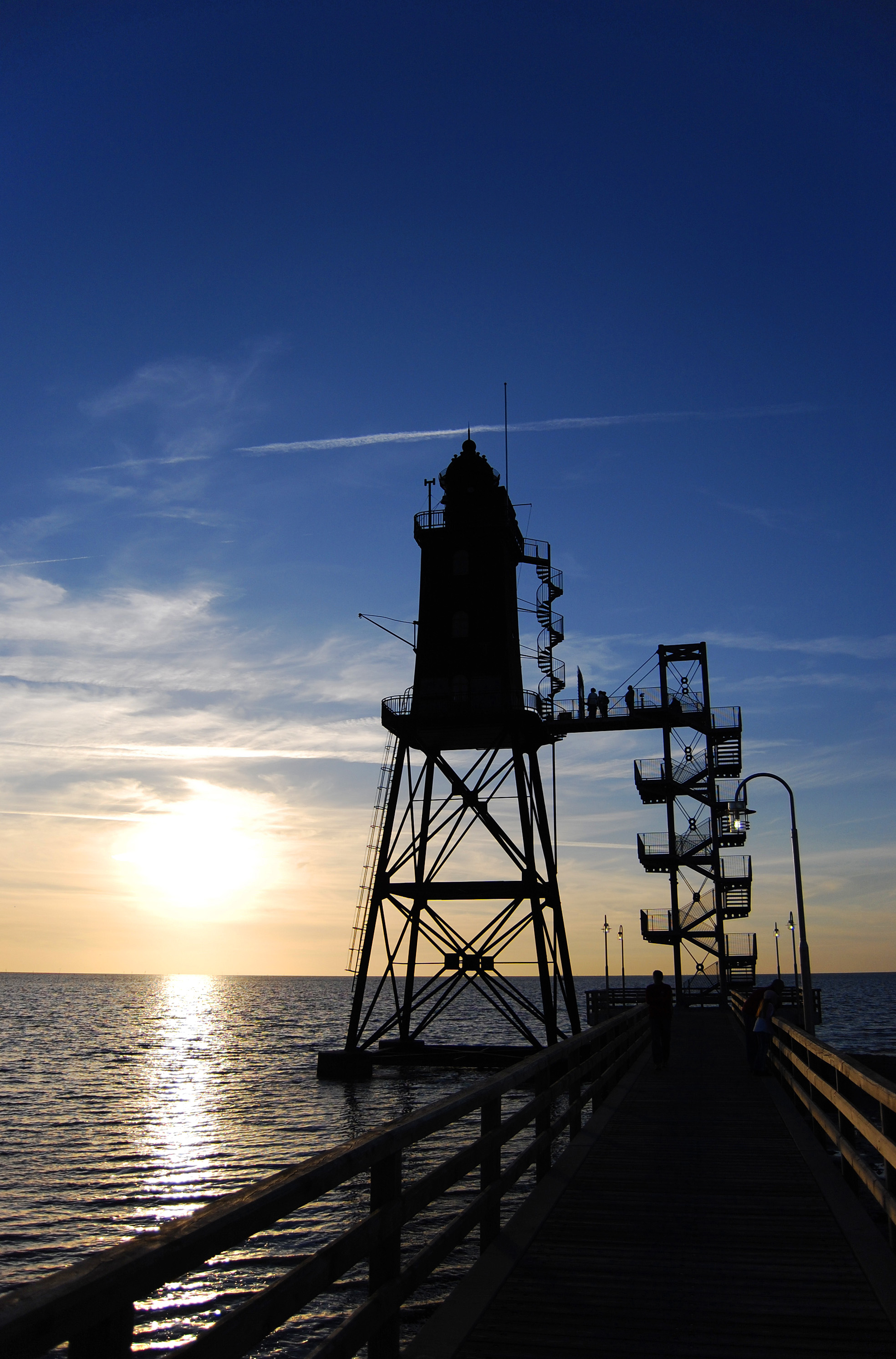
Memmertfeuer lighthouse at Juist harbour, East Frisian Islands. Small harbour lights and leading lights complement the buoyage system on the routes to the barrier islands. (Wikimedia Commons / CC)
Traffic Separation Schemes in German Waters
Several traffic separation schemes (TSS) operate in German waters, established under IMO (International Maritime Organization) provisions and implemented through German maritime law. TSS are designated to separate opposing traffic flows in congested or hazardous areas. Vessels must proceed in the appropriate traffic lane and avoid crossing separation zones except at as nearly right angles as possible.
Terschelling — German Bight TSS
This TSS covers the south-eastern North Sea and routes vessels approaching the German and Dutch coasts in an organised manner. Inbound traffic from the west follows the north-eastern lane; outbound traffic occupies the south-western lane, with a separation zone between them.
Elbe Approach TSS
The Elbe approach carries some of the world's heaviest deep-draught commercial traffic. A two-way traffic separation scheme operates in the outer Elbe approach, transitioning to a single deep-draft channel with overtaking restricted areas as vessels enter the estuary proper. Vessel Traffic Service (VTS) Elbe operates on VHF and provides mandatory reporting points and traffic information to vessels transiting the scheme.
The Kiel Canal
The Nord-Ostsee-Kanal (Kiel Canal) — the world's busiest artificial waterway by vessel count — connects the North Sea at Brunsbüttel to the Baltic at Kiel-Holtenau. Traffic in the canal is controlled by the Waterways and Shipping Authority (Wasserstraßen- und Schifffahrtsamt), with port control and lockage organised at both ends. Speed limits, overtaking restrictions and compulsory pilotage apply to many vessel categories.
Light Characteristic Notation
German nautical charts and the BSH List of Lights use IALA-standard abbreviations for light characteristics. Commonly encountered abbreviations include:
- Fl — Flashing (single flash, period > eclipse)
- Fl(2) — Group flashing, two flashes
- Iso — Isophase (equal light and dark intervals)
- Oc — Occulting (light > darkness)
- VQ — Very quick flashing (over 100 flashes/min)
- Q — Quick flashing (60–90 flashes/min)
- LFl — Long flash (light ≥ 2 seconds)
- W / R / G — White / Red / Green (colour sector)
Pilotage on German Waterways
Compulsory pilotage applies to vessels above certain sizes on the approaches to major German ports. The Elbe, Weser, Jade, Ems and the approaches to Baltic ports each have designated pilot boarding areas. The exact size thresholds and compulsory zones are published by the relevant Wasserstraßen- und Schifffahrtsamt and should be checked against current regulations for any commercial voyage.
Helgoland — the only offshore island in Germany — provides a pilot boarding point for vessels approaching from the north-west. The pilot cutter maintains a position in the roads at Helgoland for vessels requesting pilot services for the Elbe or Weser approaches.